

Town twinning predates World War II, but it spread quickly after the war as a way to promote reconciliation and friendship. In the United States, President Eisenhower launched the sister city movement in 1956 through his People-to-People program. There was also an economic component to the concept to encourage trade and tourism. In 1988, Japan’s local governments jointly established the Council of Local Authorities for International Relations (CLAIR) to support their international exchange, including sister city ties.
By that time, Kobe was a veteran hand at forging these civic familial relationships. In 1957, Kobe made its first such bond with Seattle, Washington, in the United States. The matchmaker was Clifton B. Foster, the US public affairs officer stationed in Kobe, who in December 1956 asked the city whether it would like a long-term partnership with an American city. Seattle’s mayor formally proposed the tie in 1957, and an official ceremony was held in Kobe on October 21, 1957, to welcome a delegation from Seattle and launch the partnership.
What Do Sister Cities Do?
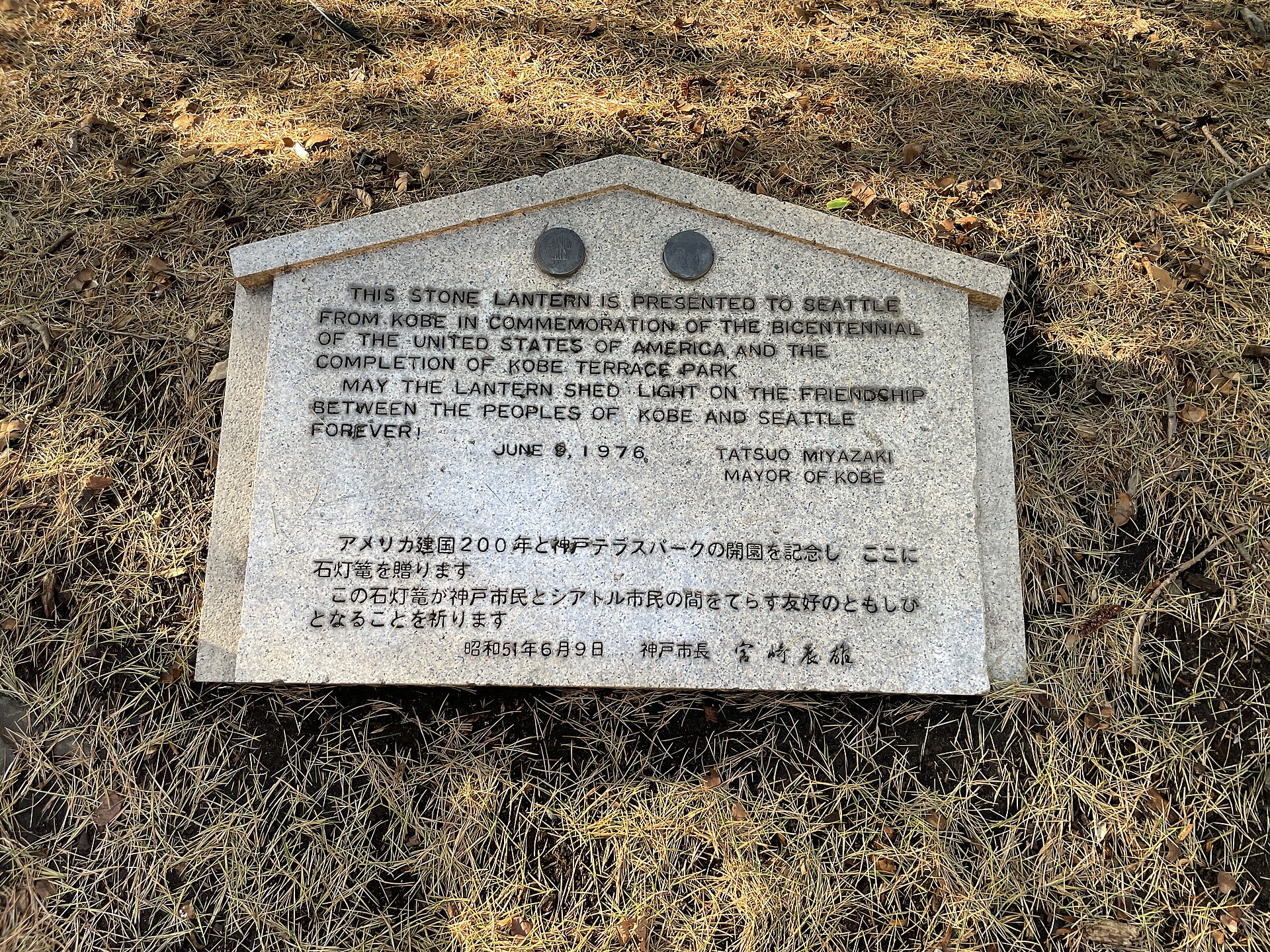
Over the decades, the two cities have organized many cultural exchanges and events coordinated by the Seattle-Kobe Sister City Association. Gifts from the people of Kobe have created Kobe Terrace, a hillside park in Seattle’s Chinatown-International District, with Japanese pine and cherry trees shading a stone lantern. The Kobe Municipal Arboretum also has a “Seattle Forest” section.
Seattle’s gifts to Kobe include a gas lamp in Meriken Park, the “Seattle Stone” peace monument in Port Island South Park, two totem poles now at the Kobe Municipal Arboretum, a story pole installed at Higashi Yuenchi in 2024, and a bronze sea otter statue, “Prince Williams,” now at Kobe Suma Sea World. The rhododendrons that bloom each spring at the arboretum also came from Seattle.
The sister city relationship between Kobe and Seattle has spilled over into the institutions of the two port cities. The Port of Kobe and the Port of Seattle have enjoyed a formal relationship since 1967. The Seattle YMCA and Kobe YMCA have engaged in a partnership even longer. The Seattle Yacht Club and Suma Yacht Club have had maritime exchanges since 1981.
One of the highlights of this nearly seven-decade alliance is the Jazz Exchange Program. Each year the winner of the Kobe Shinkaichi Jazz Vocal Queen Contest, held in the city regarded as the birthplace of Japanese jazz, travels to Seattle to perform. In return, a high school and an adult vocalist chosen at Seattle’s fall audition perform in Kobe at the Shinkaichi Music Street Festival the following May.
Other Sister Cities
Today, Kobe has sister cities on four other continents. Some of its major sister cities include:
- Marseille, France (1961)
- Rio de Janeiro, Brazil (1969)
- Riga, Latvia (1974)
- Brisbane, Australia (1985)
- Barcelona, Spain (1993)
- Incheon, South Korea (2010)
However, its relationship with Tianjin in China is one of the most interesting. In 1973, Tianjin became the first Chinese city to form a sister bond with a foreign city. The declaration occurred less than nine months after Japan and China established normal diplomatic relations. The two cities held a ceremony at the Tianjin People’s Auditorium, organized by the Japan-China Friendship Association.
At the ceremony, the two cities signed the Agreement on Establishing a Sister City Relationship between Tianjin and Kobe. The agreement detailed how the two would develop a friendship and cooperation between residents of the cities.
Neither Tianjin nor Kobe is as famous as some of the other sister cities, but there was an important reason for choosing these two cities. For one thing, Kobe has a long history of a connection with China. In the 1930s, around a third of trade from Japan to China left through the Port of Kobe. Kobe’s mayor, Tatsuo Miyazaki, raised the idea with Chinese Premier Zhou Enlai in 1972, and Zhou recommended Tianjin. Declaring a sister city solidified this relationship and paved the way forward for a bond between Japan and China.
By Steven Pavlov – Own work, CC BY-SA 4.0, Link


