

While it is perhaps Kyoto that is Japan’s best-known city for shrines and temples, it doesn’t mean that you have to go quite that far to visit some breathtaking and historic places of worship. Hiroshima Prefecture has numerous beautiful shrines and temples, some of which are absolutely stunning, and all have a great story to tell.
So, what are you waiting for? Have your juzu beads at the ready, and fill your pockets with five-yen coins for prayer, and get out there and see some of the most spectacular shrines and temples that the region has to offer.
Senko-Ji
The symbol of Onomichi, the vermillion structure of Senko-Ji, sits atop its mountain, looking out over the town. It is believed to have been founded by Kobo Daishi, a Japanese Buddhist monk, poet, and artist who established the Esoteric Shingon school of Buddhism.
A spectacular observation spot, Senko-Ji was built amongst immense rocky crags, the standout being the 15-meter-high Tama no Iwa, or “Jewel Rock.” According to local legend, Tama no Iwa would glow at night, lighting up the seas below.
Address: 15-1 Higashi Tsuchido-cho, Onomichi (map)
Mitaki-Dera
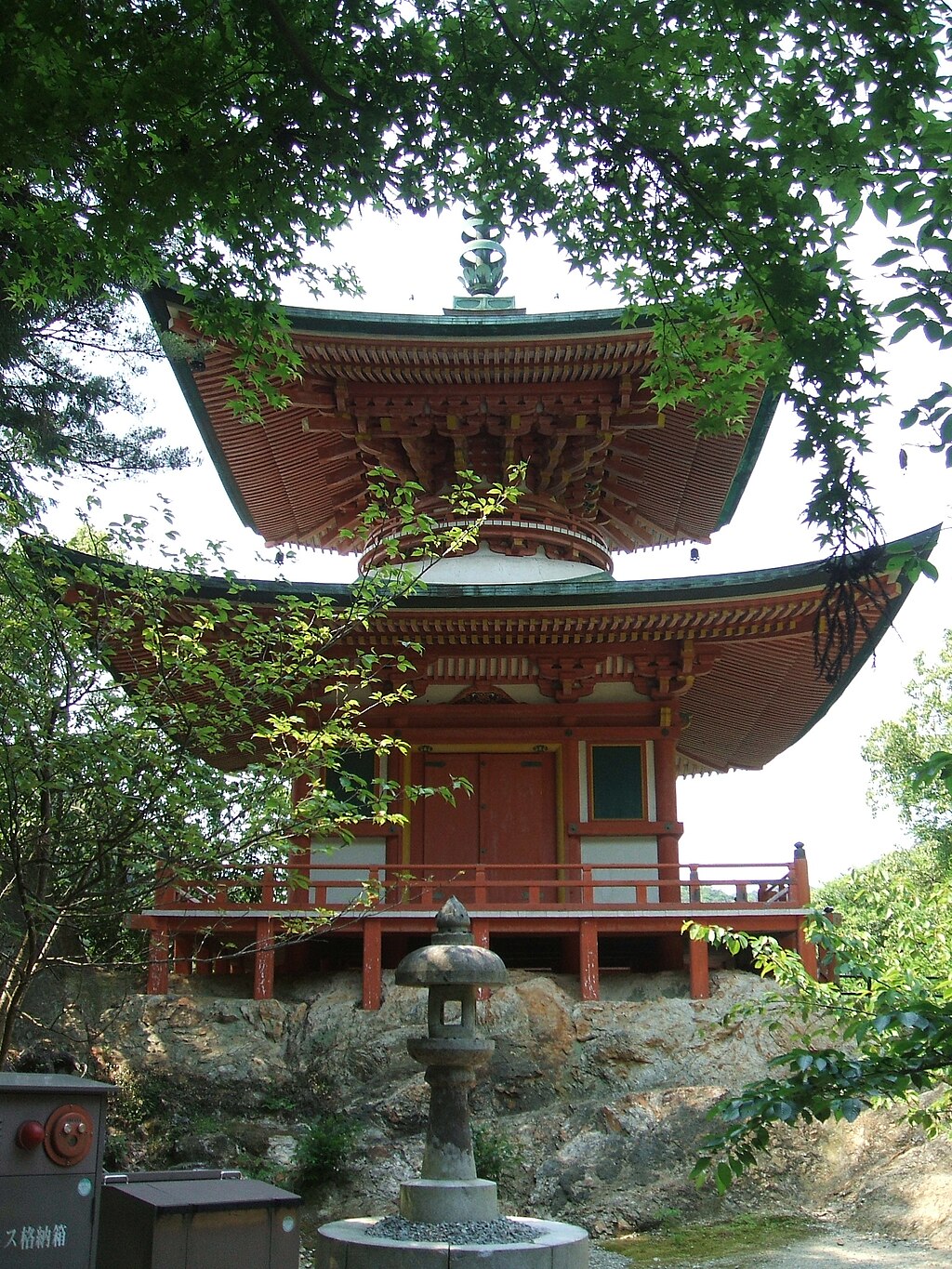
Mitaki Temple (or Mitaki-Dera) isn’t as off the beaten path as it once was. All the online references to a “hidden gem” seem to have had their inevitable effect. Mitaki is a temple of the Shingon sect and claims to have been founded in 809 AD by the wandering monk and civil engineer Kukai. The kanji used in the name refers to the three waterfalls you’ll encounter as you wander up the hill from the main gate to the Honden at the top of the central path.
One of the most noteworthy buildings in the precincts is the Tahōtō two-storied pagoda, constructed in 1526 and carried here from a shrine in Wakayama prefecture in 1951 to help appease the souls of the war-dead. Once a year, in November, the pagoda is opened to the public, who offer devotions to the Amitabha Nyorai sculpture housed within as a “secret Buddha.” On any other day of the year, though, the pagoda is lovely to look at, and the small grounds surrounding it are a pleasant place to stop for a moment.
Address: 11 Mitakiyama, Nishi Ward, Hiroshima 733-0805 (map)
Tel: 082-237-0811
Itsukushima Jinja
Listed as a UNESCO World Heritage Site, Itsukushima Shrine originates from 593, but the current structure is from 1168. While it has many stand-out features – such as a noh theater stage, the main hall, and a prayer hall, all of which are beautifully connected by boardwalks above the sea – there is no doubt that the star of the show is the iconic and world-renowned floating Torii-gate.
Unfortunately, the gate is undergoing refurbishments and is covered by scaffolding – as is a portion of the shrine. Though the stated date for completion had been August 2020, things seem to be a little bit behind schedule, and it may remain covered well into the new year.
Address: 1-1 Miyajima-cho, Hatsukaichi, Hiroshima (map)
Website: itsukushimajinja.jp
Daisho-in
Daisho-in belongs to Japan’s Shingon school of Buddhism, an esoteric sect sharing certain core features with Tibet’s Buddhism. According to tradition, the temple was founded in 806 by a famous wandering monk named Kukai, often referred to by his posthumous name Kobo-Daishi. After a 100-day ritual atop the island’s central peak of Mt. Misen, he established the temple and continued his journeys.
Daisho-in is often overlooked by travelers simply because it’s somewhat out of the way. Make an effort to head up the hill, though, and you’ll find yourself amply rewarded. First, just past the guardian statues flanking the temple’s Niomon Gate, you have a choice to head straight up the stairs, turning prayer wheels as you climb, or turn left to wind your way up along a path lined with statues of the Buddha’s disciples. Some highlights include the ‘tainaimeguri’ dark walk beneath the Kannon-do, which is a fun way to begin your temple tour and confers a ritual rebirth if you need a spiritual rejuvenation. Inside that building, you’ll find a sand mandala as well as the statue of the Eleven-faced Kannon, thought to have been made in Nara around the year 700.
Address: Hiroshima-ken, Hatsukaichi-shi, Miyajimachō, 210 (map)
Website: daisho-in.com
Shinsho-ji Zen Museum and Gardens
More than just a temple or shrine, Shinshoji Zen Museum and Gardens comprises of a collection of buildings, including a reconstructed teahouse by Sen no Rikyu, architecture from the Kamakura Period, and the Kohtei Art Pavillion, a structure that looks like a spaceship designed in an ancient parallel Japanese universe, though is intended to represent a boat floating upon a sea of pebbles.
In addition to the temple, buildings, artwork, and gardens, Shinsho-Ji allows visitors to discover monks’ daily lives from the Zen branch of Buddhism. As well as walking the same paths that the ‘unsui’ [training monks] do, and appreciating the same tranquility, visitors may also indulge in Shinso-Ji udon, a noodle dish accompanied by five condiments, served in the same way that the unsui eat them.
Address: 91 Numakumacho, Fukuyama, Hiroshima (map)
Website: szmg.jp
Houkoku
One of the oldest shrines in Hiroshima, Houkoku was built in the 16th century to honor fallen soldiers. It’s on Miyajima island, located close to Itsukushima – in fact, it originally served as the sutra hall for for the island’s most famous shrine. It was more commonly known at the time as Senjokaku. This ancient shrine is beautiful and big. It can fit around 1,000 prayer mats inside the structure and is famed for its display of over 100 ema (pictures of horses).
Address: 1-1 Miyajimacho, Hatsukaichi, Hiroshima 739-0588
Website: https://www.miyajima.or.jp/english/spot/spot_other.html
Buttsu-ji
This 14th century Buddhist temple sits deep within the mountains and forests on the outskirts of Hiroshima prefecture. It’s located 50 minutes away by bus from Mihara station. Many would say the glorious setting that awaits you is worth the journey time, particularly during the autumn season. Given the environment in which it sits, it’s no surprise that Buttsu-ji is a popular venue for zen training and meditation. Within the temple grounds, you will also find a teahouse and a small shop selling pottery.
Address: 22 Moyomaya, Takasakacho, Mihara, Hiroshima 928-0471
Carpkazu, CC BY-SA 3.0, via Wikimedia Commons


