

Japan is at the top of the list of countries that face the most danger from earthquakes. Geologists talk about the subduction of the restless Philippine Sea plate that lies beneath the Okinawa plate and the Amurian plate that triggers high-intensity earthquakes. Many cities of Japan carry sad memories of earthquakes that have ravaged their region. Not all of Japan’s most destructive earthquakes come from those offshore plate boundaries, however. Some of the worst have struck directly beneath cities, along active faults running through the crust itself.
Kobe’s tragedy began at 5:46 a.m. on January 17, 1995. The epicenter of what would become known to history as the Great Hanshin/Awaji earthquake was at the northern end of Awaji Island, 20 kilometers south of the Kobe waterfront. The seismic event lasted only around 20 seconds but was more powerful than a typical Japanese earthquake because it occurred along an active fault line. These “inland shallow earthquakes” are extremely fearsome because they begin so close to the earth’s surface.
The Scope of the Disaster in Kobe
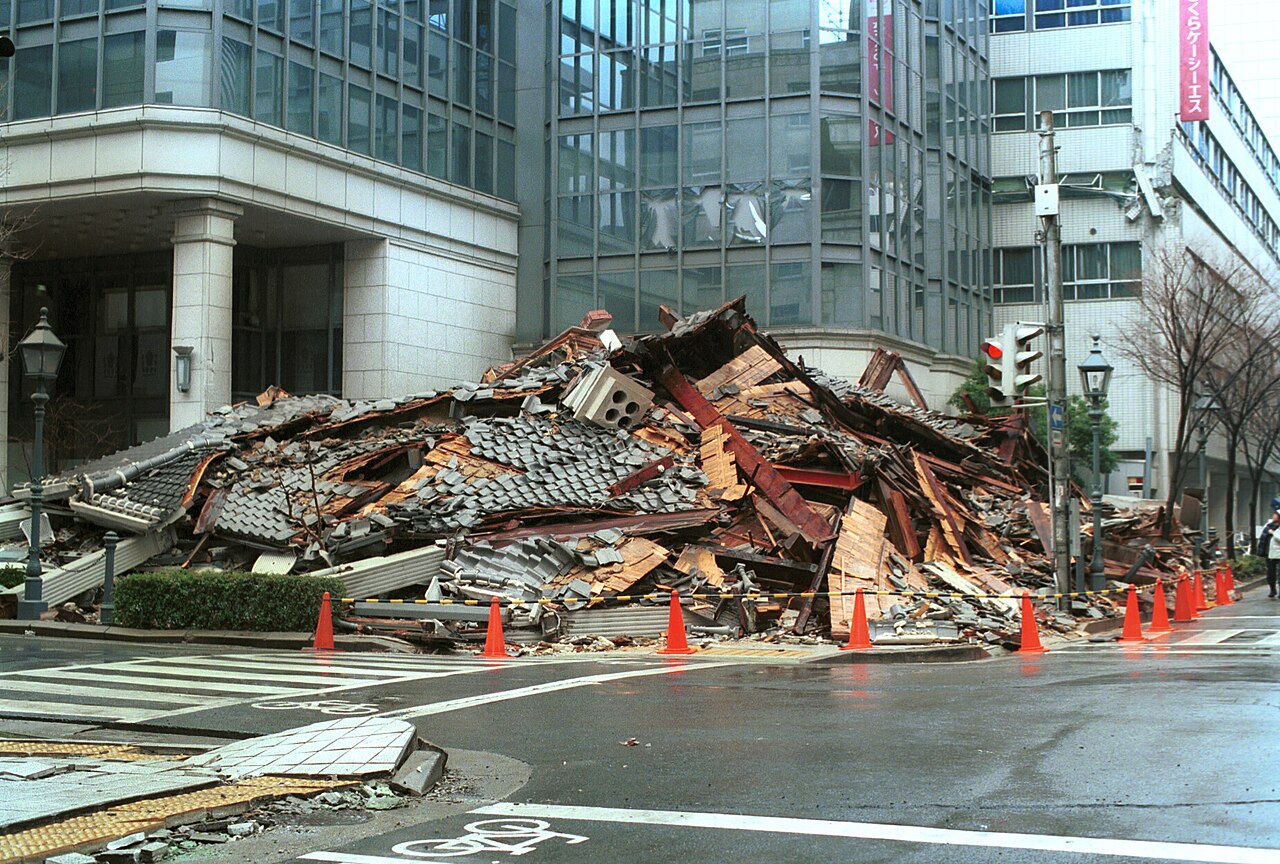
In Kobe, the overhead Hanshin Expressway toppled and around 105,000 buildings were destroyed and a further 144,000 damaged. Of the 150 quays in the Kobe port, the sixth largest container port in the world at the time, 120 collapsed. Almost one-quarter of the central business district was rendered unusable. The rebuilding bill was more than 10 trillion yen, which represented 2.5% of the country’s gross domestic product in 1995.
But far worse was the human toll. A total of 6,434 people were killed, most in their houses that pancaked when heavy roofs, installed to help withstand typhoon winds, collapsed. The Great Hanshin/Awaji earthquake was the worst to strike Japan in 70 years.
The Country Responds
Some good emerged from the disaster. As a country, Japan had little volunteer culture before the Kobe earthquake. But the destruction was on such a massive scale that an estimated 1.38 million people donated their time to help rebuild the city. Since then, grassroots activism and volunteerism have become ingrained in Japanese life.
The power of the Great Hanshin/Awaji earthquake, the first to register a seismic intensity of 7 on the Japanese shindo scale, also shook the country’s civil engineers, and disaster prevention became a national priority. For instance, they installed rubber blocks in buildings to help absorb shock. Before 1995 had ended, the Japanese government declared that January 17 would now be “Disaster Prevention and Volunteerism Day.”
Remembering the Earthquake Today
Three decades later, Kobe has not forgotten. You can learn about the earthquake and its impact in several places around the city.
The Disaster Reduction and Human Renovation Institution Museum
Officially called the Disaster Reduction and Human Renovation Institution Museum (DRI), but more commonly known as Kobe Earthquake Memorial Museum, the DRI opened in 2002. In addition to information about the Great Hanshin/Awaji Earthquake, the museum educates visitors about the tremors that plague Japan and what we can do to prevent widespread disaster.
One of the most harrowing exhibits is called “The Impact at 5:46.” This seven-minute video recreates what it was like to live through the earthquake. Following this, visitors can experience the aftermath through a diorama of Kobe streets. They then continue the journey with a 15-minute documentary, diorama, and exhibitions showing the efforts to reconstruct the city, including stories from survivors. Finally, you can learn about how to prepare for natural disasters and minimize their impact through interactive activities and in the Gallery of Disaster Prevention for the Future.
To reach the museum, take either the Hanshin Electric Railway from Iwaya Station or Kasuganomichi Station (it’s a 10-minute walk from either) or the JR to Nada Station (for a 12-minute walk). Alternatively, take a Kobe City Bus to the Disaster Reduction and Human Renovation Institution stop on the 29 or 101 line.
Opening hours are 9:30 a.m. to 5:30 p.m. (last admission is 4:30 p.m.). The museum is closed on Mondays (or Tuesdays when Monday is a national holiday) and over the New Year holiday. There is free admission every 17th of the month (or 18th when the museum is closed on the 17th).
Port of Kobe Earthquake Memorial Park
Meriken Park is the site of the Earthquake Memorial Monument. A segment of the wharf that was twisted into ruins is preserved to show the destruction of the quake. There are also models, movies, and photograph exhibits, with explanations in English and Japanese. Lastly, a round black disk is cut to symbolize a clock at 5:46 a.m., the time of the earthquake.
Kobe Luminarie
A further remembrance of the victims occurs for ten days in the winter, when 200,000 hand-painted lights illuminate the streets around Meriken Park during the Kobe Luminarie. Now entering its 32nd year, it is confirmed for January 29 to February 7, 2027. Note that for 2027 part of the Meriken Park site becomes a paid area requiring a special viewing ticket, priced from 500 to 750 yen in advance and 1,000 to 1,500 yen on the day.
Hokudan Earthquake Memorial Park and Nojima Fault Preservation Museum
Awaji Island, the epicenter of the earthquake, has set up its own museum to commemorate the event and its victims: Hokudan Earthquake Memorial Park and Nojima Fault Preservation Museum.
The main thing to see here is the Nojima Fault itself. Exposed due to the earthquake, visitors can see how the ground buckled, causing one side of the fault to become higher than the other. A home located almost upon the fault line survived the earthquake and is preserved as part of the museum. Other exhibits include a simulator of the Great Hanshin/Awaji Earthquake as well as for the Tohoku Earthquake of 2011, allowing you to experience how the events differed.
The museum is open from 9:00 a.m. to 5:00 p.m. every day, except New Year. Reach the museum by taking a bus to the Hokudan Earthquake Memorial Park stop from the Iwaya Port.
No machine-readable author provided. Hebi~commonswiki assumed (based on copyright claims)., CC BY-SA 2.5, via Wikimedia Commons


