

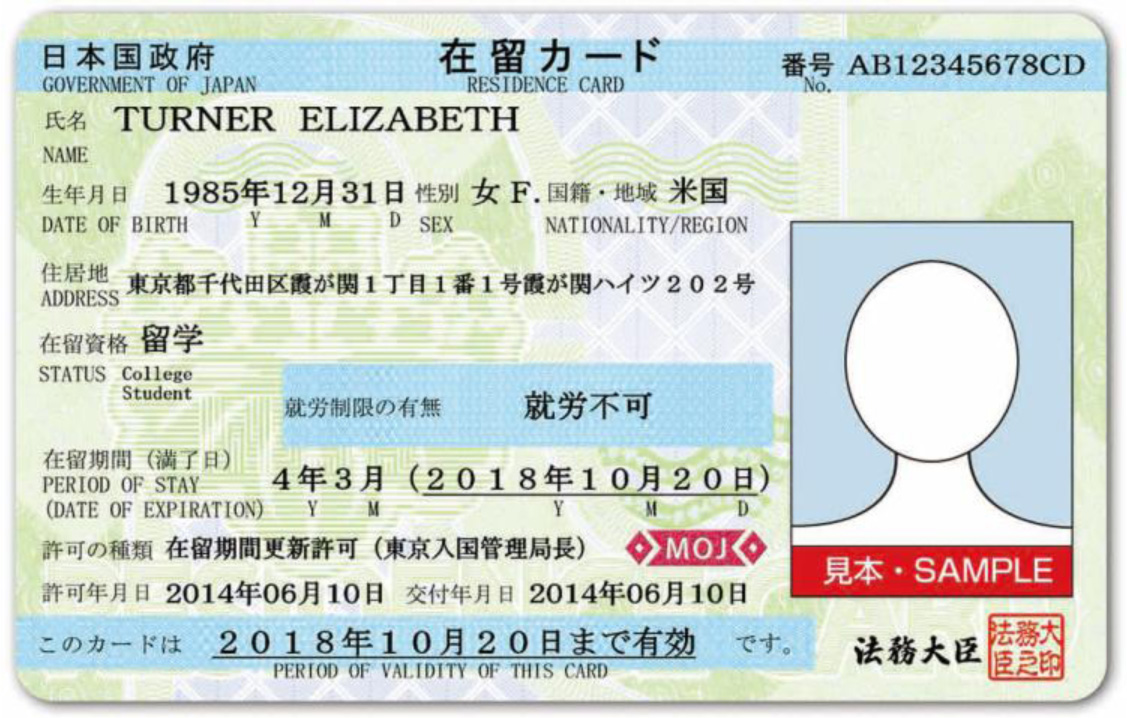
When I foolishly lost my wallet on a sightseeing tour of Tokyo, I was less concerned by the loss of cash than I was of the idea of getting my official documentation back, particularly my residence card. As it turns out, I needn’t have been so worried. Recovering your card just takes a couple of simple steps.
Step 1: Lost Report Certificate
The first thing I did was head to the nearest koban (police box) to explain the situation. This worried me at first, as my Japanese is barely passable and I was unsure how I could explain the situation. Luckily, I remembered the word for wallet, “saifu,” and mimed it disappearing. If I had been paying more attention in my Japanese lessons, I would have said, “Saifu wo otoshite, Zairyū kādo wo nakunarimashita.” (I have lost my wallet and my residence card).
Fortunately, the police officer knew what to do. Using a multilingual form, he took down my details. Then, he took out a book with explanations of situations in various languages that helped me (after pointing out that, although the characters look alike, I required the English section rather than the Portuguese) understand what would happen next.
If you find yourself in a similar situation, locate your nearest police station and request a “Lost Item Report Certificate.” I found out later that it is better to go to a police station rather than a police box, as police boxes are unable to issue the certificate. By heading straight to the station, you can both report your lost residence card and receive the certificate (which you’ll need when applying for the reissue of your card) at the same time.
It’s also possible that you no longer have your residence card due to theft. In this case, you’ll receive a “Theft Report Certificate” instead. Alternatively, a residence card destroyed due to a natural disaster will mean you need a “Disaster Victim Certificate.”
Step 2: Apply for a Replacement Residence Card
My next step was to go to the regional immigration bureau. You must do this within 14 days of realizing that you no longer have your residence card. If you are outside the country when you lose your card, the 14-day countdown begins from when you reenter Japan. Note that you must apply at the regional immigration bureau with jurisdiction over your registered address, not simply whichever office is nearest or most convenient. If you live in Chiba, for example, you cannot apply in Tokyo.
Upon arrival at the immigration bureau, I found the information center on the first floor, where I explained my situation. The center’s staff speak a variety of languages, but if you are unfortunate enough to come across a staff member who struggles with English, say, “Zairyū kādo wo atarashiku tsukuremasu ka.” (I need a new residence card). I was given an easy-to-complete form and directed upstairs to the main immigration center. You can also download and fill out the form in advance by heading to the Immigration Services Agency’s website. The form is called “Application for Re-Issuance of a Residence Card.”
Be aware you will also need a recent photograph for the application. There are photo booths inside the immigration centers, which are ideal for taking a photo that meets the requirements for the application. After cutting out my photo (scissors are provided in the conbini), I entered the immigration office and took a ticket. When my number was called, I handed over my application form, photo, “Lost Item Report Certificate,” and passport and, after a mere 20-minute wait, I had a shiny new residence card. An unexpectedly painless experience altogether.
All in all, a happy ending, particularly as, two weeks later, my wallet was returned to me in one piece. Japanese honesty, definitely the best thing about the country.
Who Can Apply for a Replacement Residence Card on Behalf of the Cardholder?
There are a few circumstances in which someone other than the cardholder may apply for a replacement residence card. If the cardholder is under the age of 16, a relative will need to make the application and should bring documentation proving the relationship with the cardholder. You can also ask a relative to apply on your behalf if you are unable due to illness, in which case you will need to supply a medical certificate, or if you have another valid reason for being unable to appear in person. Lastly, an agent or other authorized person who is already approved by the director of the regional immigration services bureau to act as your intermediary can apply on your behalf.
If none of the above apply, you will need to appear in person, even if it means taking time off from work or school.
The Importance of Your Residence Card
Since it is a legal requirement to carry your residence card at all times, it is crucial to take steps to recover a lost card immediately. Failing to carry your card risks a fine of up to 200,000 yen and failing to apply for a replacement within 14 days risks up to one year in prison or a fine of up to 200,000 yen. Make sure you report a lost, stolen, or damaged residence card within 14 days to prevent serious issues. In the meantime, carry your passport with you.
One further change is worth knowing about. Since June 14, 2026, it has been possible to hold a Specified Residence Card, which combines the residence card with the My Number card. Switching is optional, and existing residence cards remain valid until their expiry date, so there is no need to do anything immediately. If you do hold one, the same reporting and replacement rules apply.
Iwate Prefecture Government website, CC BY 4.0, via Wikimedia Commons


